

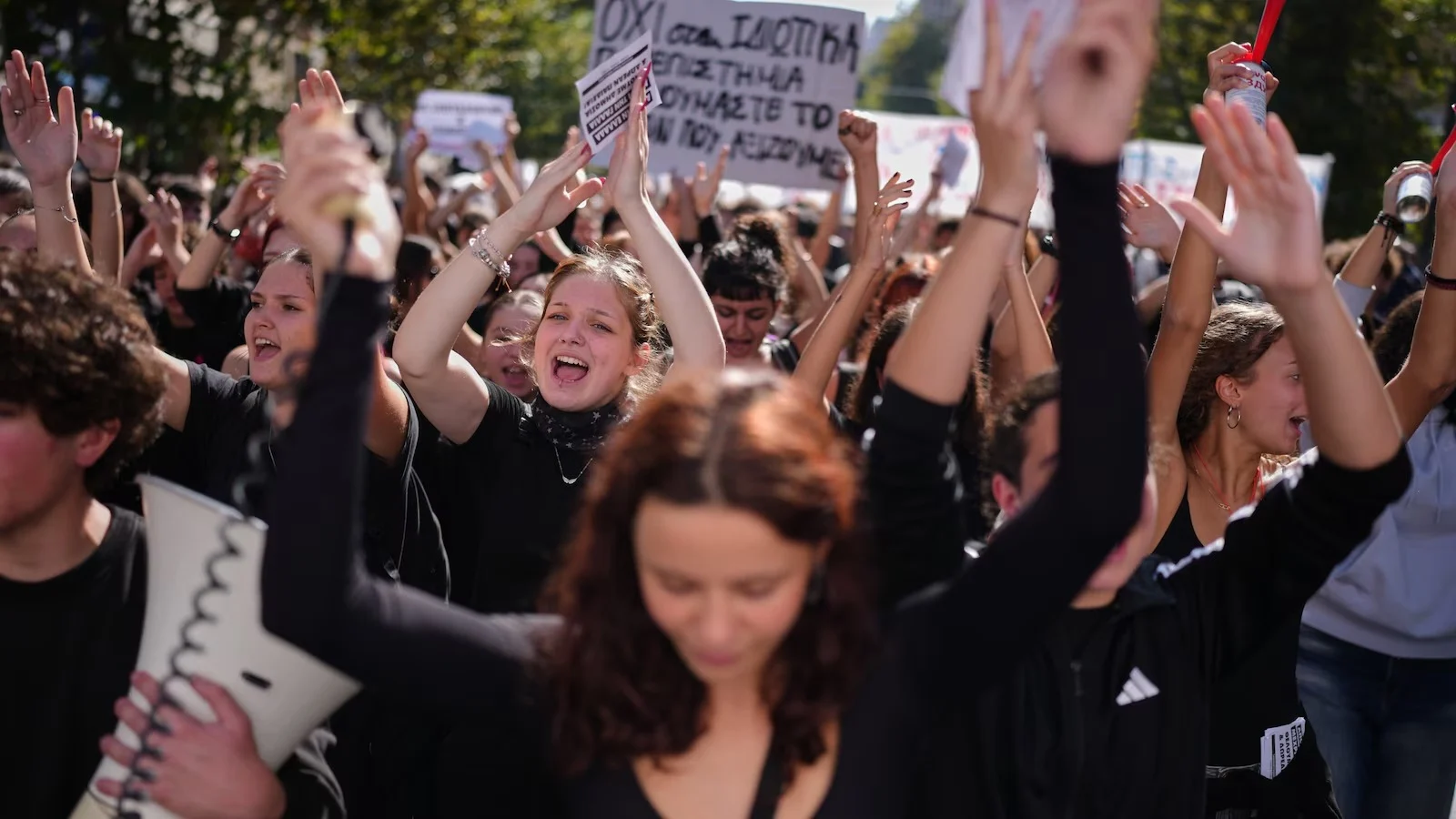
Thousands of students and teachers marched through Athens on October 21 to demand more affordable housing and greater investment in public education. Similar demonstrations took place in other Greek cities, including Thessaloniki and Patras. The protests reflected growing frustration with the cost of daily life, as families and young people struggle to manage rising expenses while trying to secure a good education.
Housing was one of the main concerns raised by students. Many young people who move away from home to attend university must pay rent, transport costs, food bills and study expenses. When rent takes up a large share of a student’s budget, there may be little left for books, travel or other basic needs. Some students may have to work long hours alongside their studies, while others may consider delaying their education or choosing a course closer to home.
Protesters criticised government support that they said did not match the scale of the problem. A monthly rent subsidy of 120 euros was among the measures under discussion, but students argued that it covered less than half of typical rent and was paid at the end of the year. For people who must pay their landlord each month, a delayed payment may offer limited help when the bill is due.
Teachers also joined the demonstrations, linking the housing issue to wider problems in public education. They said that rising household costs made it harder to reach the end of each month, while conditions in schools were getting worse. Their participation showed that the concerns were not limited to students. Educators also face financial pressure and want public services to receive enough support to meet community needs.
The demonstrations formed part of a wider wave of protests across Europe. Higher fuel costs and other living expenses have placed pressure on household budgets in several countries. In some places, protests have also focused on public services, wages and the cost of housing. Although each country has its own political and economic conditions, the shared concern is that ordinary incomes are not keeping up with the cost of a secure life.
For students, affordable housing is closely tied to equal access to education. A young person with family support may be able to study in a large city, while another with the same academic ability may struggle to pay for a room. If housing costs become a barrier, universities risk becoming less accessible to students from lower-income families.
The protest also placed pressure on policymakers to explain how their plans would improve daily life. Subsidies can provide direct help, but lasting solutions may require more student housing, better public transport and stronger investment in schools and universities. Such changes take time and public money, making clear priorities and long-term planning important.
The marches did not resolve these concerns, but they gave students and teachers a public platform to express them. Their message was that education should not become a financial burden that families cannot manage. The response from the government will help determine whether the demonstrations lead to practical changes in housing support and public education funding.
