

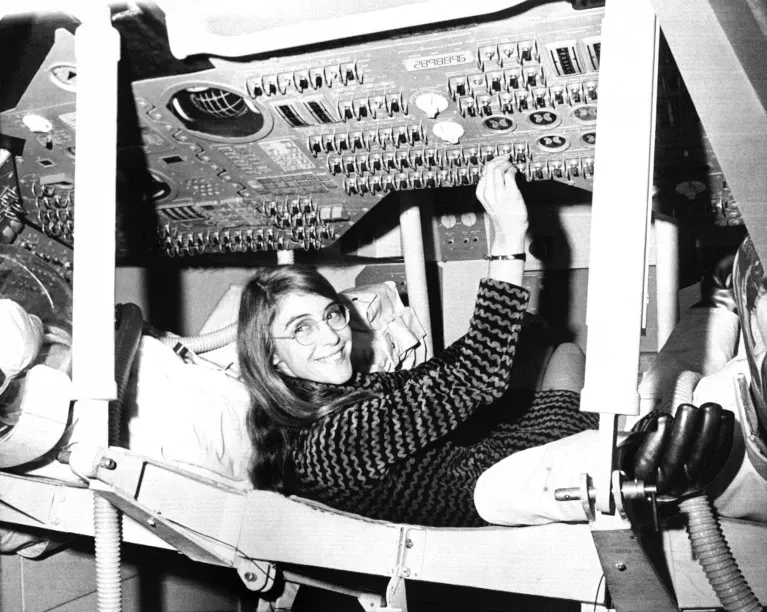
Margaret Hamilton, the computer scientist who led the team responsible for key software used in NASA’s Apollo missions, has died at the age of 90. Her work helped make the first human journeys to the Moon possible and helped establish software engineering as a vital part of modern technology. Hamilton died on September 30 in Cambridge, Massachusetts, according to her family, with news of her death reported in October.
Hamilton began her career at the Massachusetts Institute of Technology in 1959 after studying mathematics at Earlham College. At the time, computer science was still a young field, and the role of software in major engineering projects was not fully understood. She joined a team working on the systems needed for the Apollo missions and eventually became a leader in developing the software that helped guide astronauts through some of the most complex flights in history.
The Apollo missions required computers to work under extreme pressure. The spacecraft had to manage navigation, timing and other tasks while astronauts traveled far from Earth. A software error could have placed a mission at risk. Hamilton’s team helped build systems that could handle unexpected situations and give priority to the most important tasks. That work became especially important during Apollo 11, the mission that carried the first astronauts to the Moon in 1969.
Hamilton became known for her strong belief that software needed the same careful planning and testing as other parts of a spacecraft. She helped make software development a more formal discipline at a time when many people still saw it as a supporting task rather than a central part of engineering. Her work helped shape practices that are now common in industries where computers control important systems.
Her career also challenged the limits placed on women in science and technology. In the early years of her work, women often faced barriers in technical roles and leadership positions. Hamilton continued to take on major responsibilities despite those conditions. Her success became a lasting example for women who wanted to build careers in engineering, computing and scientific research.
After the Apollo era, Hamilton continued working in software and founded companies focused on computer systems. She helped develop ideas that could be used beyond space travel, including methods for building software that could be trusted in difficult conditions. Her career showed that the lessons learned from space exploration could improve systems used on Earth as well.
Hamilton received wide recognition later in life. In 2016, she was awarded the Presidential Medal of Freedom, one of the United States’ highest civilian honors. Her image beside stacks of Apollo code also became widely known, offering a striking view of the amount of work needed to create the software behind the Moon missions. She was later included in a Lego set celebrating women who helped shape NASA’s history.
Her family remembered her as an original thinker with a strong sense of humor and a quiet ability to stand firm when others doubted her. Those qualities helped her work in a field that was still taking shape and in workplaces where women were often overlooked. Her career showed that important advances can come from people who challenge accepted ideas and insist on careful work.
The Margaret Hamilton legacy reaches far beyond the Apollo program. Modern transport, medicine, communications and industry all depend on software that must work reliably. Hamilton helped show how software could become a central part of complex engineering, not just an extra tool. Her contribution remains part of the foundation on which many modern computer systems are built, and her life continues to inspire new generations of engineers and scientists.
