

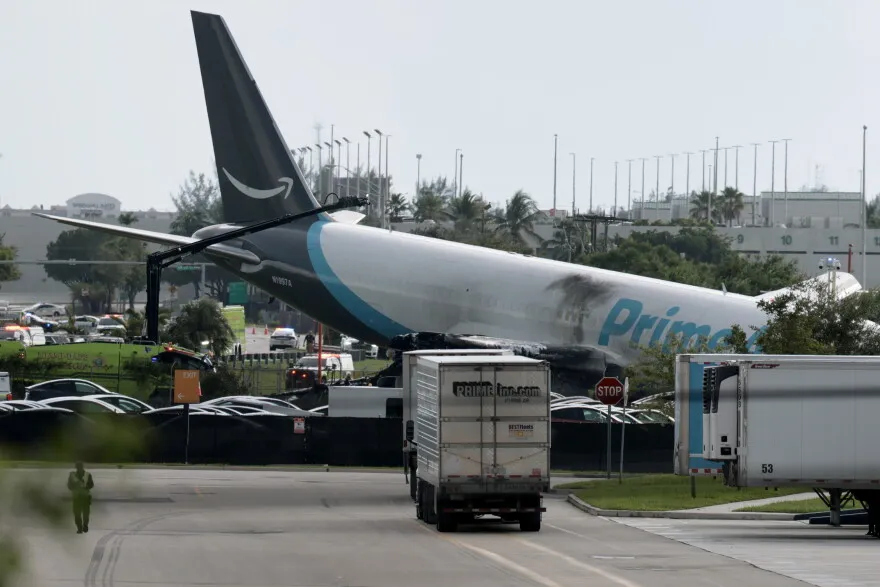
Federal investigators are examining the cause of a fiery Amazon cargo plane crash Miami incident that killed five people after a Boeing 767 ran off the runway at Miami International Airport, striking an SUV and a van carrying cleaning crew members.
The National Transportation Safety Board has focused its investigation on whether the aircraft touched down too late in its landing sequence to stop safely within the available runway length, with early evidence suggesting the plane remained airborne further down the runway than expected.
The crash, which occurred Sunday, immediately halted flight operations at one of the country’s busiest international airports, causing widespread delays and cancellations that affected thousands of travelers as authorities worked to secure the crash site and begin their investigation.
This incident represents a significant setback for cargo aviation safety, given the aircraft’s role transporting goods for one of the world’s largest e-commerce companies, whose extensive logistics network depends heavily on reliable air cargo operations across numerous airports nationwide.
Aviation safety experts note that runway overrun incidents, while relatively rare, often result from a complex combination of factors including aircraft speed, weather conditions, and pilot decision making during the critical final moments of landing approach and touchdown procedures.
The victims killed in the crash included ground personnel who were performing routine cleaning duties near the runway area when the aircraft’s uncontrolled path intersected with their vehicles, highlighting the risks ground crew members face even when not directly involved in flight operations.
Airport officials worked quickly to reroute flights and manage the significant operational disruption caused by the runway closure, though the scale of delays and cancellations reflects the airport’s status as a major hub for both passenger and cargo aviation traffic in the region.
The cargo airline operating the flight has expressed condolences to the victims’ families while committing full cooperation with investigators working to determine the precise sequence of events leading to the crash and any contributing factors that investigators may identify.
This incident adds to ongoing industry discussions about cargo aviation safety standards, particularly regarding older aircraft models still actively used in cargo operations, though investigators have not yet indicated whether aircraft age or maintenance played any role in this specific incident.
Regulatory attention following this crash will likely focus on reviewing landing procedures and safety protocols at the airport, along with broader questions about runway safety margins for aircraft models similar to the one involved in this particular incident.
As the investigation continues, aviation officials and the broader industry await findings that could inform future safety protocols. For the families of those killed, including ground crew members simply performing routine duties, this tragedy represents a devastating and sudden loss connected to what should have been a routine cargo flight operation.
