

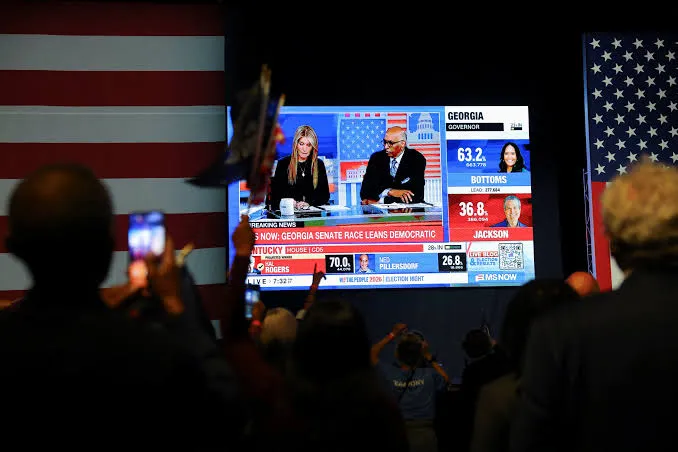
Global financial markets moved lower on Wednesday after Democrats won control of both chambers of the United States Congress, prompting investors to reconsider the future of technology investment and economic policy. The election result created uncertainty for companies that have benefited from rapid growth in artificial intelligence, as investors expect stronger political scrutiny of the sector. The US dollar also weakened, reaching a one-month low, while government bonds gained as traders moved towards assets viewed as safer during periods of uncertainty. The reaction spread across international markets, showing how closely global investment decisions are connected to political developments in the United States.
The Democratic victory was wider than many investors had expected. The party secured Senate seats in states including South Carolina, Texas and Ohio, while also gaining control of the House of Representatives. Several districts that had been considered strongly Republican shifted towards Democratic candidates. The scale of the result raised questions about whether the new congressional majority would support tighter rules for technology companies, particularly businesses building large artificial intelligence systems and data centres. Investors had become increasingly concerned about the amount of money being spent on AI infrastructure and whether the industry could maintain its current pace of expansion.
Technology shares were among the first to react. Companies involved in chip production and data-centre development faced selling pressure as traders assessed the possibility of additional regulation. The AI boom has supported major stock market gains in recent years, with large technology companies investing heavily in computing equipment, cloud services and electricity infrastructure. These projects have created opportunities for suppliers across several industries. However, the concentration of market growth around a relatively small group of technology businesses has also made investors sensitive to political decisions that could affect the sector.
The possibility of new restrictions on data-centre construction attracted particular attention. Texas has become an important location for large computing projects because of its available land, energy resources and business environment. Investors are concerned that stronger local or federal rules could delay some planned developments. Analysts also noted that the election result could influence decisions involving government contracts, healthcare, banking and defence. Although a Democratic Congress may not be able to pass every major policy proposal, it could increase oversight and make some business decisions more difficult.
The bond market moved in the opposite direction from shares. US Treasury prices rose as investors sought more stable assets, pushing the yield on the benchmark 10-year Treasury note down by six basis points to 4.906%. Lower yields can reduce some borrowing costs, although the effect on mortgages and business loans depends on wider market conditions. The dollar index fell by 0.37% to 101.34, while the euro and British pound strengthened. The Japanese yen and Swiss franc also gained as investors looked for currencies traditionally associated with financial stability.
Asian markets were affected by the uncertainty surrounding US technology policy. Major chipmakers, including Samsung, SK Hynix and TSMC, initially recorded losses before recovering some ground. These companies supply essential components for AI systems and depend on demand from American technology firms. Any slowdown in data-centre investment could therefore affect manufacturers throughout the international semiconductor supply chain. The market response showed that the consequences of US political decisions can extend far beyond American companies and investors.
Oil prices also remained unsettled as traders considered the possibility of diplomatic progress in the wars involving Iran and Ukraine. Lower energy prices could ease inflation pressure, but renewed attacks or supply disruptions could quickly change expectations. Investors are now watching how the new Congress approaches technology regulation, government spending and international policy. The initial market decline may not determine the longer-term direction of shares, but it highlights how political change can influence investment confidence. Companies and investors will need to assess whether the new balance of power creates new opportunities or increases uncertainty across the global economy.
