

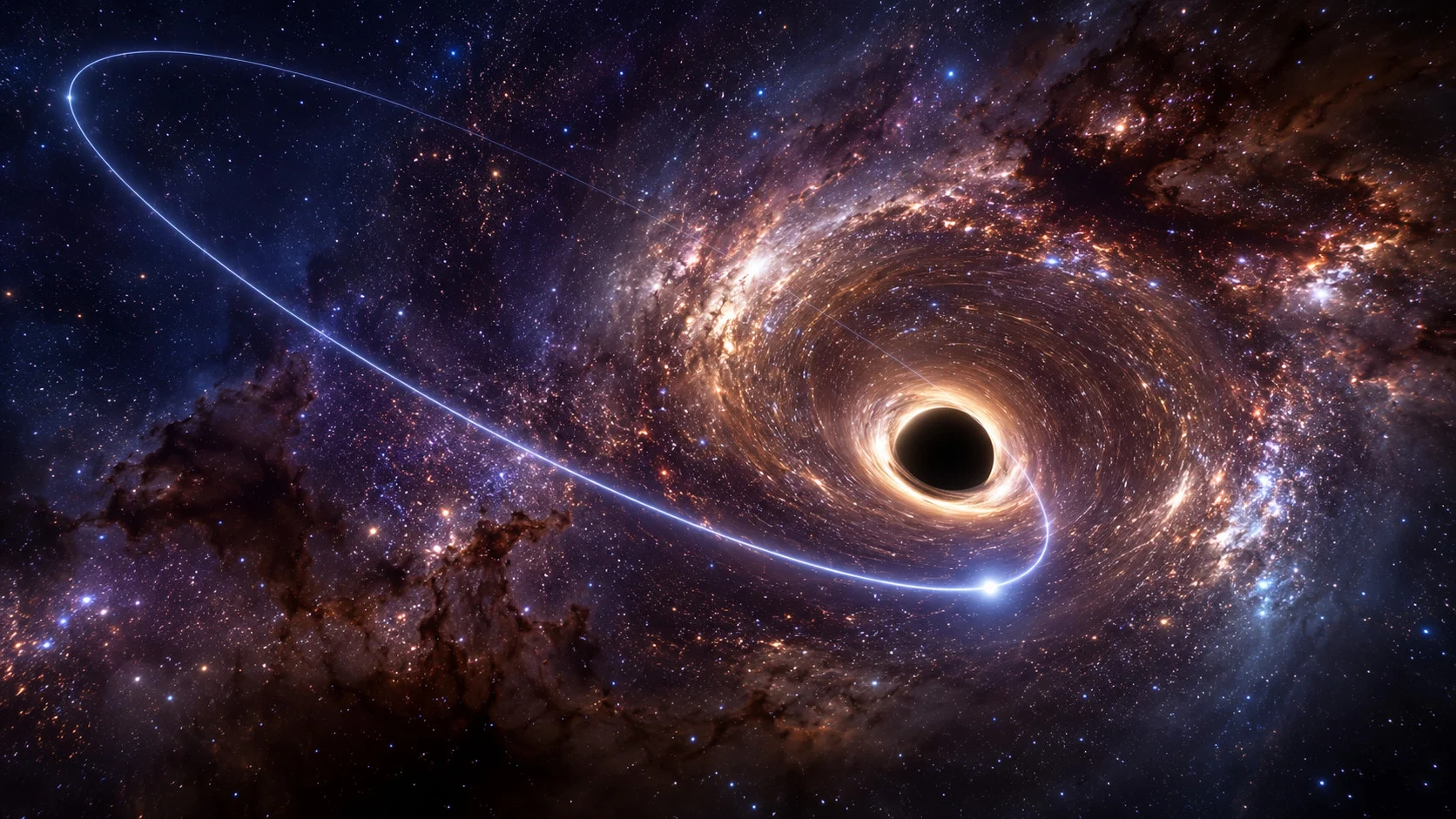
Astronomers have found the fastest known star in the Milky Way. The star, named S301, is moving at about 25,000km per second near the huge black hole at the centre of our galaxy.
That speed is about 100,000 times faster than a commercial plane. S301 is also the closest known star to Sagittarius A*, the supermassive black hole at the centre of the Milky Way.
The star follows a very tight orbit around Sagittarius A*. It takes only 8.7 years to complete one full orbit. At its closest point, S301 comes within about 12 times the distance between Earth and the Sun.
Felix Mang, a PhD student at the Max Planck Institute for Extraterrestrial Physics in Germany, said the star’s orbit is unlike any seen before. He said its close path around Sagittarius A* could provide new information about the black hole.
The discovery could help scientists study one of the key properties of Sagittarius A*: its spin. Like many black holes, Sagittarius A* is expected to rotate.
Einstein’s general theory of relativity predicts that a spinning black hole can drag space and time around it. This effect is known as frame dragging. It can change the paths of objects moving close to a rapidly spinning black hole.
S301 has a highly eccentric orbit. This means its path is stretched rather than being close to a perfect circle. Its tight orbit and high speed make it a useful target for testing this effect.
Scientists hope the star could help them measure the spin of Sagittarius A* more directly. Such a measurement would provide an important test of Einstein’s theory in an extreme environment.
Stefan Gillessen, a senior scientist at the Max Planck Institute for Extraterrestrial Physics, said the star may allow researchers to measure the spin of a massive black hole for the first time in a direct way.
The study was published in the journal Nature. Scientists traced S301’s orbit back to observations made in 2017. They also plan to track the star during its next close passage in 2031.
The extra observations could provide enough data to estimate the spin of Sagittarius A*. Researchers hope this work could produce a result within the next decade.
The observations were made with the European Southern Observatory’s Very Large Telescope Interferometer in Chile. The system combines light from four large telescopes. This allows scientists to make very detailed observations of objects near the centre of the Milky Way.
Despite its extreme speed and close orbit, S301 is not expected to fall into the black hole. It does not appear to be on a path that will take it across the event horizon.
The event horizon is the boundary around a black hole beyond which nothing can escape. S301 is expected to remain in its orbit instead of being swallowed by Sagittarius A*.
Felix Mang said black holes are often described as objects that pull in everything around them. However, he noted that a black hole also acts as a massive object around which other bodies can orbit.
Dr Ziri Younsi, an astrophysicist at University College London who was not involved in the study, called the discovery important. He noted that S301 travels at about 8% of the speed of light at its fastest point.
The star’s extreme orbit could help scientists learn more about Sagittarius A* and the space around it. It may also improve understanding of how the Milky Way’s central black hole developed over time.
For now, S301 gives researchers a rare chance to study a star moving through one of the most extreme regions in the galaxy. Its future observations could offer a new way to test the laws of physics close to a supermassive black hole.
